
Take Control of Your Life
Take Control of Your Life
Internal Links
Why Balance Declines, and Why You Don't Have to Accept It?
Senior’s Summary (Read This First)
If your lifestyle does not control your body, your body will control your lifestyle.
That’s not a threat — it’s a reality many people discover too late.
• Inactivity and poor nutrition slowly limit what your body can do
• Extra weight, weakness, and stiffness reduce independence
• Loss of function leads to loss of choice
• The Aging Curve explains why this happens — and how to push back
• Small, consistent lifestyle choices restore control at any age
This is not about perfection. It’s about direction.
For most of my life, I believed my body would always do what I asked of it.
If I wanted to work harder, I did. If I wanted to move faster, I could. If something felt stiff or sore, I assumed it would pass. Like most people, I never questioned that assumption — until my body began answering back in ways I didn’t expect.
That’s when I learned a simple truth:
If your lifestyle does not control your body, your body will control your lifestyle.
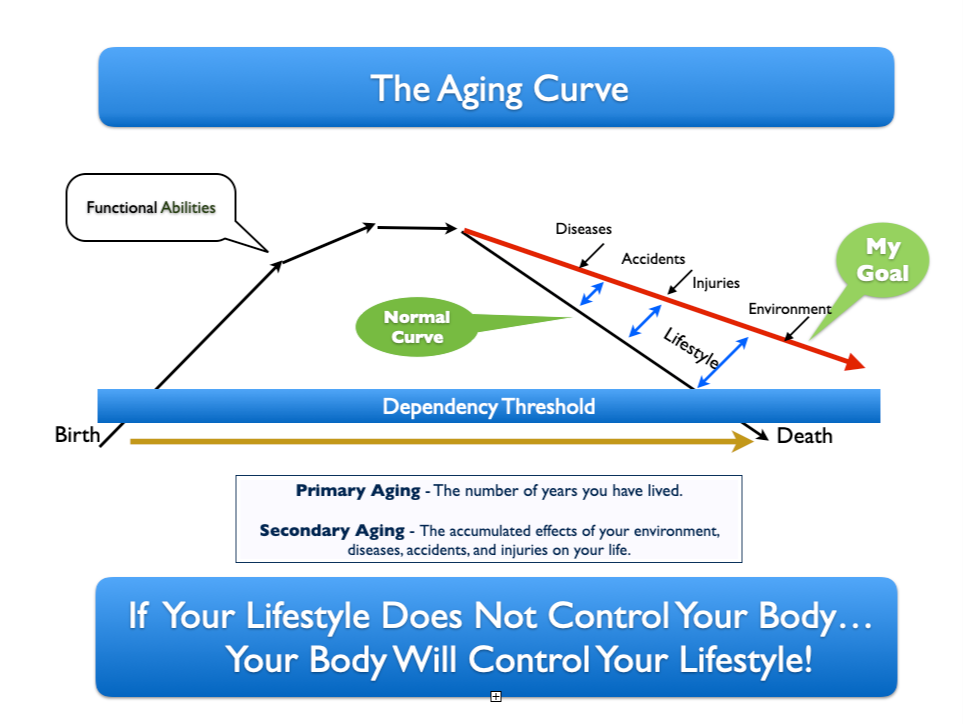
This idea sits at the heart of what I call the Aging Curve.
What the Aging Curve Really Shows
The Aging Curve is not about getting old. It’s about function.
Early in life, we gain abilities — strength, balance, coordination, endurance. Later in life, we lose them. That loss can happen slowly and gently, or quickly and aggressively. The difference is not age alone. It’s lifestyle.
There is a point on the Aging Curve called the dependency threshold. When you fall below it, everyday tasks become difficult or impossible without help.
Getting out of a chair.
Climbing stairs.
Carrying groceries.
Getting down to the floor — and back up again.
When those abilities disappear, your body begins making decisions for you.
When the Body Takes Control
Most limitations don’t arrive all at once. They creep in.
You stop walking as far because it feels uncomfortable.
You avoid certain movements because you feel unsteady.
You carry extra weight because eating well and moving regularly “takes too much effort.”
Over time, these small compromises add up.
Extra body fat strains joints, raises inflammation, and interferes with movement. Weak muscles reduce stability and confidence. Poor balance increases fall risk. Limited mobility restricts where you can go and what you can do.
At that point, it’s no longer a matter of motivation.
It’s a matter of ability.
Your body has taken control.
This Is Not a Weight Issue — It’s a Function Issue
Being overweight is not the problem by itself. The real issue is what excess weight does to function.
When the body carries more than it can comfortably manage:
-
Movement becomes harder
-
Recovery slows
-
Energy drops
-
Pain increases
-
Activity decreases
That cycle accelerates decline.
Eventually, people don’t stop exercising because they lack willpower.
They stop because their body no longer cooperates.
Lifestyle Is the Only Lever That Works
You cannot control aging.
You cannot control genetics.
You cannot control accidents or illness.
But you can control how strong, mobile, balanced, and resilient your body becomes as you age.
Lifestyle is not a slogan. It’s a daily input.
Exercise teaches your body how to function.
Nutrition determines how well it recovers and adapts.
Together, they decide whether your Aging Curve drifts downward — or is pushed back up.
Control Is Built Through Simple Actions
Taking control of your body does not require extreme workouts or perfect eating.
It requires consistency.
Walking regularly.
Strengthening muscles that support daily life.
Practicing balance so confidence returns.
Eating food that supports health instead of undermining it.
These actions restore ability. And ability restores choice.
When your body is strong and mobile, you decide:
-
where you go
-
how long you stay
-
what you do
That is freedom.
The Bottom Line
If you do nothing, your body will decide your limits for you.
If you move, strengthen, and nourish your body consistently, you decide your limits.
That is the difference between living reactively and living deliberately.
Your lifestyle can control your body — or your body can control your lifestyle.
The choice is made every day.
And that choice shapes your Aging Curve.